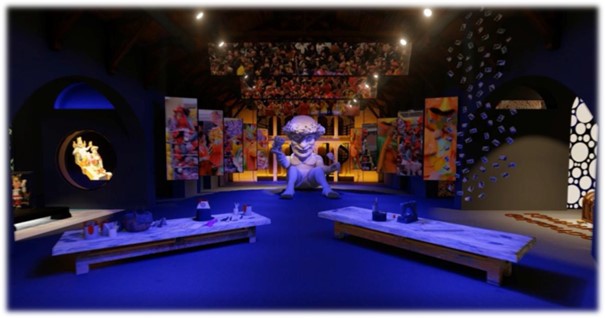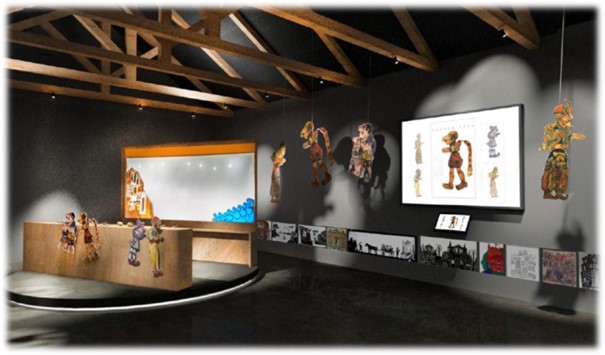
The Municipality of Patras, with the sole aim of satisfying the needs of the people of Patras and focusing on children, in collaboration with the vibrant forces of the city, has breathed life and meaning into the ruined “shell” of the Old Slaughterhouses, which it took over in 2014 from the municipal authorities. The latter had entrusted it to “investors” to conduct business, avoid paying rents to the municipality, and loot it.
Since 2020, with the completion of the Sparc program, funded by the European Territorial Cooperation program “Interreg Greece – Italy 2014 – 2020,” the space now houses the carnival organization (KEDIP – Patras Carnival), hosts annual educational workshops for the city’s students on the Carnival and Karagiozis, and has also come to life hosting exhibitions, cultural events, concerts, and conferences.
The efforts continued to complete the Old Slaughterhouses into a multipurpose cultural space for creativity and expression, with a focus on Karagiozis and the Carnival.
The Municipal Authority, along with the systematic work of the employees in space, supported by the proposal of the interdisciplinary team for the utilization of the Old Slaughterhouses, prepared and submitted a funding proposal to the Recovery Fund, which brought positive results.
The proposal, titled: “Education Hub for Culture and Creative Industry,” was approved by the relevant services of the Ministry of Culture and included in the Recovery Fund with a budget of €4,178,882, with the carnival organization (KEDIP – Patras Carnival) as the implementing body.
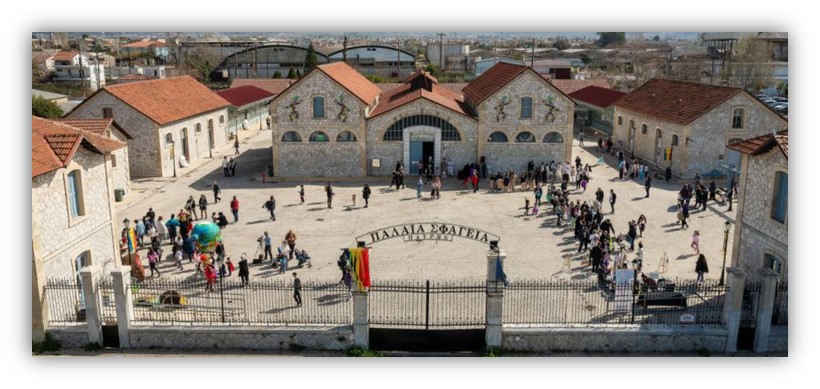
The Old Slaughterhouses, like the whole city, are changing.
The Municipal Authority aims to utilize every last euro to deliver to Patras a space for learning, knowledge, creation, entertainment, and a multifaceted experience, centered around the Carnival and Karagiozis. A new landmark for our city that will not only host cultural activities all year round but will also offer educational, training, and qualification programs related to culture. As part of this program, the workshop in Petrotos is also being modernized to increase the quantity and improve the quality of carnival constructions.
The model and comprehensive centers for showcasing and studying (Museums) K6 Carnival, K7 Karagiozis, will become an attraction for visitors to our city. Additionally, the large thematic carnival park to be developed in the outdoor spaces will be welcoming for our younger friends and will simultaneously function as an exhibition space for carnival constructions. In this way, our city will have what it deserves: A cultural center and landmark for the people of Patras, a point of reference for our children, and a magnet for visitors.
A Multifunctional Cultural Space with a focus on the Carnival and Karagiozis through the SPARC Program.
The space of the Old Slaughterhouses is transforming into a multifunctional cultural space, with the Carnival and Karagiozis at its heart. The space’s development is being funded by the Sparc program, part of the “European Territorial Cooperation – Interreg Greece – Italy 2014 – 2020” operational program.
The implementation of this project is an important development in the events of the Patras Carnival, the city’s top cultural event with international reach. It extends activities beyond the carnival period, taking place throughout the year. Additionally, it highlights the importance of the Shadow Theatre as a significant cultural product of Patras, the birthplace of the Hellenized Karagiozis.
The multipurpose space of the Old Slaughterhouses first opened with the Summer Carnival Festival Sparc, which took place from September 21 to 27, 2020, and was funded by the “European Territorial Cooperation – Interreg Greece – Italy 2014 – 2020” program. For a week, numerous artistic events, theater performances, concerts, visual art installations, exhibitions, and workshops brought the Old Slaughterhouses to life, both indoors and outdoors, filling the space with vibrant artistic energy. This marked the venue with a distinctive carnival imprint within a broader cultural and satirical framework, capturing the interest of a large audience.
At the same time, the headquarters of the Patras Municipality’s Public Utility Company – Patras Carnival, a project partner of Sparc, was moved to the Old Slaughterhouses. The administrative services of the Public Utility Company now operate across two buildings in the multipurpose space, successfully integrating the program with the Patras Carnival. The interdisciplinary team, which collaborated closely with the Municipality of Patras and the Public Utility Company – Patras Carnival, submitted the study for the operation of the Old Slaughterhouses, working to complete the creation of the multifunctional cultural space focused on the Carnival and Karagiozis (a space for creation and promotion), as well as the tangible and intangible heritage it entails, with a strong creative, digital, audiovisual, educational, social, and participatory character. The goal was to integrate the city’s creative forces into shaping a cultural entertainment experience centered on people, strongly tied not only to intellectual and social aspects but also to the developmental dimension of Patras.
The Old Slaughterhouses complex, in its final form, includes:
- The main large hall dedicated to the Patras Carnival, serving as a space for multi-theme exhibitions with a focus on the Carnival, an interactive space for carnival explorations, and a venue for digital exhibitions.
- The Karagiozis Shadow Theatre hall, displaying archival and exhibition material with interactive experiences for the public with Karagiozis.
- A multipurpose hall for artistic activities (dance, theater, performance, periodic installations and exhibitions, meetings, events, screenings).
- Three workshop rooms (Creative Industry workshop, Creative workshop for children and youth, and 3D applications workshop).
- A multimedia center (Multimedia Center, image and sound production and editing workshop, Digital Library/DJ studio/Visual Effects).
- A radio station (Radio Studio and Recording Studio).
- A gift shop and a creative meeting room.
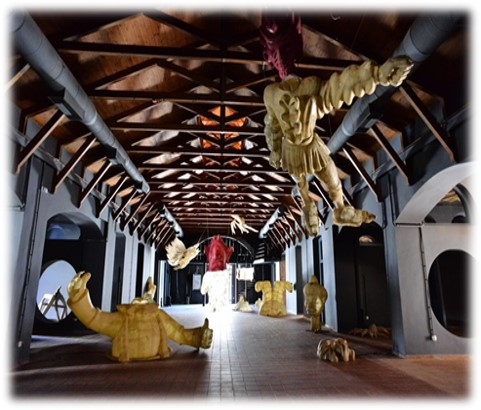
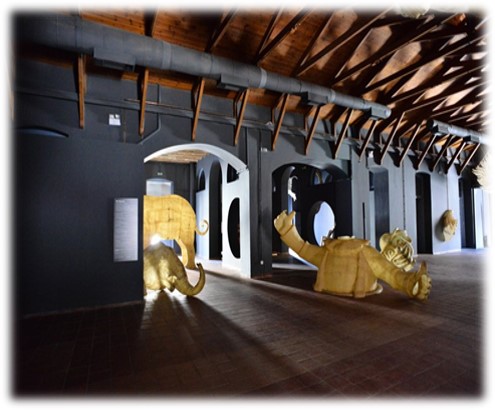
The inauguration of the Creative HUB took place on Saturday 26 of June 2021.
Key facts:
- The city of Patras holds a series of events every year, among which the Patras’ Carnival Festival is also co-financed by RWG (Axis4 of the Regional Action Plan/RAP). CCIs’ however had no “shelter”.
- A joint project proposal has been elaborated by RWG & Patras Municipality to provide both the missing building infrastructure and the missing CCIs’ policy support.
- The project benefited from GR-IT funding for the renovation of the old slaughterhouses of Patras at the forefront of policy support aiming to set up a Creative Hub to promote local cultural creativity.
- The 2.200m2 building, situated in a large complex area of 10.000m2 was built in 1903 and declared “Work of Art” by the Ministry of Culture; it operated as a leisure Centre under private investors from 2006 till 2012, practically abandoned ever since.
- The main implementation tool was a series of targeted calls within the Interreg GR-IT project, along with a sustained communication campaign to early engage local stakeholders and local CCIs. These set the basis for structured policy support.
- 3 are the main stakeholders, with complementary roles within the local practice: RWG, Municipality of Patras, and Achaia Chamber of Commerce. Beneficiaries are local CCIs and the general public.
- Specific target groups have been also addressed through activities of significant added value for the local cultural sector, as the ones related to the Patras’ Carnival.
Resources:
1,4 M€ provided by the GR-IT CBC project for the setup of the whole Patras’ Creative Hub and not just for the building renovation works. Upon completion, additional funding (>4 M€) has been secured through the Recovery Fund/RF project number 2023ΤΑ01400046.
Evidence of success
Upon completion of the GR-IT project, RWG secured additional funding (RF) for the Patras’ Creative Hub to pursue operation, upgrading regional support (Axis 4 of RAP) into an explicit CCIs’ policy action. Figures below, demonstrate local uptake, 1 year after the initial GR-IT CBC project closure:
- More than 30 workshops for CCIs
- More than 80 cultural events
- More than 120 creative activities for schools
Patras’ Mayor used above success to justify membership to the network of “Intercultural cities programme” of the CoE.
Potential for learning or transfer
(a) Relevance: “Patras’ Creative Hub” stands for local CCIs’ support, structured upon completion of GR-IT project.
(b) Impact: restauration & safeguard of an historic, yet abandoned building allowed for:
- regeneration of the wider area and adjacent coastal zone.
- housing local CCIs
- local uptake: > 60.000 people visited the hub till 08/2023
(c) Replicability lies with a shared and jointly elaborated (by the region, the city and CCIs’ representatives) project linking up the CCIs’ needs with local and regional potential (funds & resources).
(d) Sustainability secured by RWG via 1) a new RF project 2) a new GR-IT project (currently under evaluation) 3) RIS3 of RWG and the corresponding CCI sector where thematic linkages will be considered along with Patras’ Creative Hub results’ upgrade.
(e) Innovation lies in successfully upgrading local CCIs’ support into the regional scale.
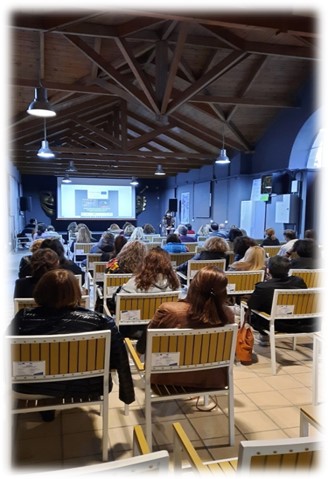
Programme’s expert opinion:
The Creative Hub of Patras is an important good practice demonstrating how cultural policy and infrastructure can be combined to support local creative and cultural industries (CCIs). Developed through a partnership between the Region of Western Greece and the Municipality of Patras, the initiative transformed a historic, abandoned slaughterhouse into a vibrant cultural centre. It offers long-term support to local CCIs, who previously lacked a dedicated space, while preserving cultural heritage and revitalising the surrounding area. The hub’s impact is already visible: within one year, it hosted over 30 workshops for CCIs, 80 cultural events, and 120 school activities, attracting more than 60,000 visitors. Its activities are closely linked to major local events like the Patras Carnival, anchoring it firmly in the city’s cultural identity. The project’s success has secured further investment from the Recovery and Resilience Fund. This practice is highly transferable for other European regions aiming to revitalise underused heritage spaces, strengthen their local creative economies, and promote inclusive cultural development through coordinated regional and municipal collaboration.
Further information: